
- News
- City News
- chennai News
- ‘Green TN mission needs to be about tree growing, not planting’
Trending
This story is from September 13, 2023
‘Green TN mission needs to be about tree growing, not planting’
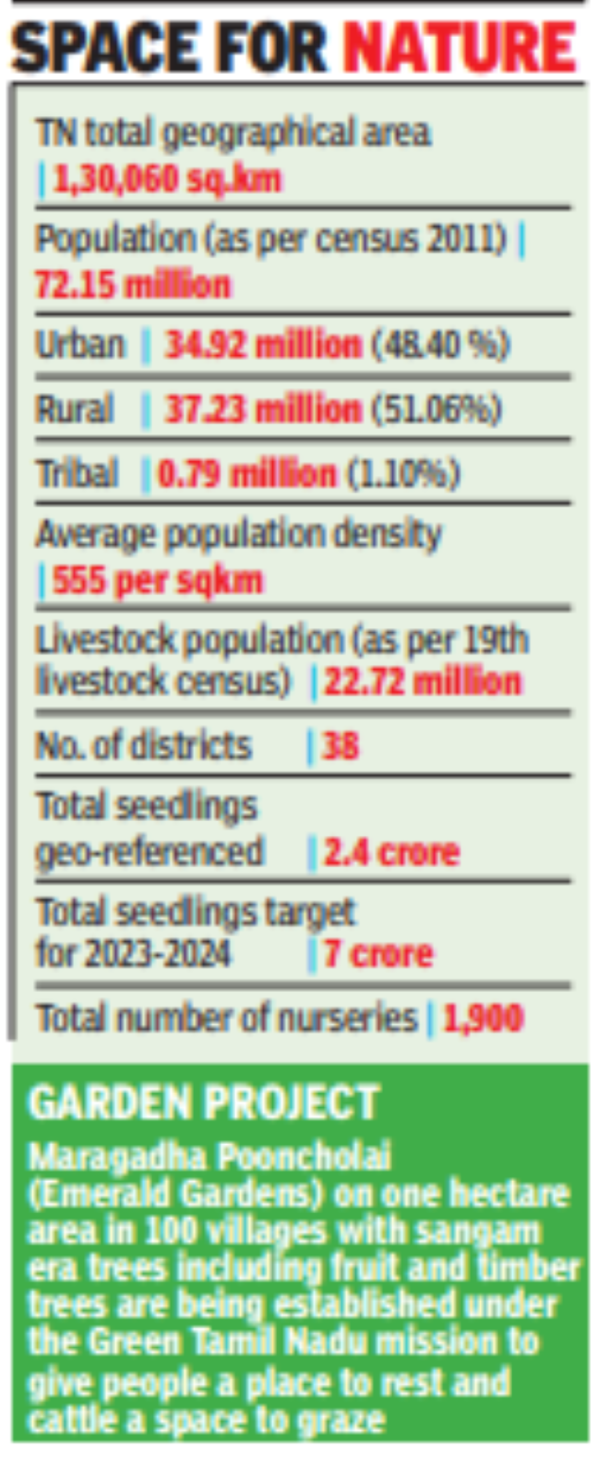
It has been two years since Green Tamil Nadu Mission (GTM), a flagship programme of the state government was launched by Tamil Nadu chief minister M K Stalin in 2021. Its target — to grow the green cover from 23.76% to 33% of the total geographical area (TGA) in the next ten years.
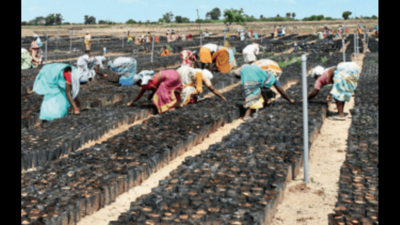
Mission director Deepak Srivastava says they are roping in MGNREGS workers to help with taking care of trees
But while the state forest department — the implementing agency of the mission — is busy procuring seedlings through nurseries to reach the target of planting 260 crore trees of indigenous species over an area of 12,000sqkm in the next decade, green activists are calling for the assessment of the project to make it more effective.

Green mission director Deepak Srivastava says the trees planted have a survival rate of 80% to 90%, but experts estimate that it is merely 20%. “Since farmers are encouraged to plant the saplings in their fields, we are confident they will maintain them,” says Srivastava. Nothing though is being done from the government side to ensure this, say activists.
“Tree plantation drives are a routine but ineffective affair in Tamil Nadu. Trees are being planted for the sake of a target. Nurturing the saplings is forgotten,” says A Gregory, project director of Voice Trust and national green corps coordinator in Trichy. “The drive ought to be a tree ‘growing’ mission instead of a tree ‘planting’ mission.”
Here is how the mission works. The forest department is entrusted with growing saplings in nurseries and distributing them to the other government departments and the public. The planted seedlings are georeferenced for effective monitoring. In the second year of the project, district collectors have been asked to rope in the corporation, district rural development agency and the school education department and has allotted ₹50 crore towards the mission for 2023-24.
“A sapling needs proper care like watering twice a week and more frequently in summer. Unfortunately, that does not happen in this system,” says a senior officer in the forest department requesting anonymity.
Another officer in the forest department says the departments entrusted with the responsibility of planting saplings raised by the forest department in their nurseries are reluctant to take it up due to a lack of funds.
Though large-scale nurturing of the saplings is not being done, there are a few individuals who have taken up the task. A Udhayakumar from Thiruvadanai, a retired school teacher for example from the arid Ramanathapuram district says he uses tree guards to shield the plants. “They just cost ₹500 each. That’s all you need to protect the young tree. Still, it is not being done.”
Srivastava though says the green mission is not just about planting but geo-referencing as well. “We will release funds to other departments too once we get them through donations from corporates and the public,” he says. “As of now, we are releasing funds to the forest department for raising nurseries. We haven’t been able to mobilise corporate funds but we are confident we can. We have spent ₹85 crore in raising nurseries.”
Srivastava says they also have a plan to involve panchayats, self-help groups and tribal communities to raise nurseries. “We will purchase seedlings from them thereby also giving them a livelihood.”
The government launched a scheme in January to mobilise funds from the public, corporate organisations and people welfare associations and also to ensure stakeholder participation on the lines of Namukku name thittam which has raised ₹45 lakh from corporate organisations and individuals.
“We have directed the forest department to liaise with local bodies to use treated water for the plants. We can think of tree guards only when we start getting funds from the public. I would suggest people using air-conditioners which emit 1,350 kg of Co2 to donate for raising 100 saplings,” says Srivastava.
Gregory suggests village panchayats rope in workers of the Mahatma Gandhi National Rural Employment Guarantee Scheme (MGNREGS) as tree protectors. “This can be an additional income for them,” he says. “We can make unemployed youth green brigadiers. We want to connect to panchayats to do this. We are also working on the idea of using MGNREGS workers,” says Srivastava.
I Sahayaraj, coordinator of the Eco Club at RC Higher Secondary School in Trichy, who has turned his school campus into an orchard in two decades, says students can be encouraged to take up tree plantation in their homes by incentivising them with credits that can be useful for their education and employment. “We incentivise our students by gifting them geometry boxes and other stationery items for planting and caring for trees. Just dumping saplings on youngsters and forcing them to plant them won’t yield desired results,” says Sahayaraj.
Some officials are trying various schemes and fines to make the mission work. Trichy collector M Pradeep Kumar has decided to plant one crore seedlings in two years in the district. “The seedlings will be planted using the Miyawaki method to create dense forest areas. Institutions and individuals can collect saplings from us for free.
They should ensure every sapling is grown or they will be fined ₹10 per sapling,” says Kumar. He has chosen five villages including Sanamangalam in Mannachanallur Taluk for the green mission. The first batch of 50 lakh seedlings will be planted in August 2024, he says.
‘Tree’ P Thomas of Trees Research Education and Environmental Services (TREES) Trust says green cover expansion does not require large funds. It just requires interest from local body heads. Individuals are doing it without any funding.”
Activists also point out the lack of space for planting trees in small housing plots. “The government advocates planting a tree for every one cut but does not make it mandatory to leave space for planting trees when giving approvals for housing plans.
Change needs to begin at the policy level,” says M Syed, president of Green Care and member of the district green committee of Coimbatore district. “A tree takes 50 years to reach its full growth,” says Syed, who has been involved in missions to save trees and replant them for the past 23 years.
“We will add new dimensions to make Tamil Nadu green and climate resilient. This project is advancing in a scientific manner,” says Srivastava.
End of Article
FOLLOW US ON SOCIAL MEDIA










Hot Picks
TOP TRENDING
Trending Stories
In City
Entire Website
- GK for students: Top 8 Largest Mammals in the World
- Arvind Kejriwal Resignation Live Updates: 'Kejriwal will be back', says Atishi after staking claim; BJP questions CM-designate's 'background'
- India vs China Highlights, Asian Champions Trophy 2024 Final: Jugraj Singh stars as India beat China 1-0 to clinch record fifth title
- Kolkata Murder Supreme Court Hearing Live Updates: Court extends ex-RG Kar principal Ghosh, cop's custody by 3 days
- Maharashtra schools closed on Sep 18: Here’s why
- Communal tension hits Karnataka towns over Palestinian flags at rallies
- 'If any shame left ... ': AAP slams Swati Maliwal's remark on Atishi, says she should seek RS ticket from BJP
- Work on bridges gains pace to ease Ghodbunder jams
- NMDC Steel Plant Seeks 100 Officers of Vizag Steel Plant
- UGC NET Result 2024 Live Updates: NTA expected to announced final answer key, scorecards shortly
- 8 killed, over 2,700 hurt after 1000s of pagers explode across Lebanon; Hezbollah blames Israel
- ‘Kheer brought back …’: PM gets emotional remembering mother on b'day
- ‘Oxford returnee’ to Delhi CM: The rise and rise of Atishi
- J&K returns to polling booth after a decade; Phase 1 of voting tomorrow
- Sri Lanka presidential polls: What's at stake for India
- Was Israel behind pagers exploding across Lebanon?
- Cow vigilantes killing a Brahmin is the wake-up call India needed
- Intel CEO announces major restructuring, tells employees: 'We need to fight for …'
- Trump says Biden-Harris rhetoric causing assassination bids; Dems blame Trump
- Escaping riots in Bangladesh & prostitution in Chennai, woman lands in jail

Popular Categories
Hot on the Web
Top Trends
Dominique PelicotUS Fed Rate CutIndia vs China Champions TrophyUPI Transaction LimitWhere to Watch India vs China Final Hockey MatchUPS vs NPS CalculatorKolkata Commissioner Manoj VermaNEET UG Admission CriteriaAtishiKolkata Doctor Rape CaseArvind Kejriwal Resignation LiveAli Khamenei TweetSuryakumar YadavVince McMahonTech LayoffsDonald TrumpLive Cricket Score
Trending Topics
Munawar FaruquiLuxury BrandCancer CauseKhatron Ke Khiladi 14Chinas EggAtishi Marlena Singh QualificationSunita AhujaGoat CollectionSalman Khan FarmhousePitra Paksha 2024CheetahsKangana RanautAditi Rao HydariDalljiet KaurHoliday DestinationVikas SethiReliance Jio DownApple iPhone 16 ProVirat KohliWordle Answer
Living and entertainment
Latest News
Lava Blaze 3 5G with 50MP camera, MediaTek chipset launched in IndiaPankaj Kapur is proud of son Shahid Kapoor’s film choices, calls him ‘the finest actor in the country’4 types of tea to improve gut health and ease digestive issuesKhatron Ke Khiladi 14: Shalin Bhanot hosts a fun party for his co-contestants Krishna Shroff, Abhishek Kumar, KaranVeer Mehra and othersDecoding how log analytics systems are enabling brands to derive maximum value from dataKitchen Tips: How to elevate home cooking to Michelin levelAnother Mpox suspected case in India: Man showing symptoms admitted to hospitalLiza Colon becomes 1st Latina to win Best Supporting Emmy AwardSelena Gomez recreates practiced applause she learnt from TV show Friends after losing at Emmys 2024Former WWE superstar is no longer listed on their internal rostersBeyond Paychecks: Job satisfaction, work-life balance more important than salary for Gen Z workforce‘You is sleep or you can sleep’: Students prank Benglauru’s ‘pookie professor’ in viral videoHow ‘Oxford returnee’ Atishi became chief minister of DelhiWhy more couples aged 50 or older are getting divorcedThese are the most toxic fresh produce of 2024Police detain Rajasthan govt school principal for passing lewd comments on girlPics; Monalisa visits Lalbaugcha Raja with husband Vikrant SinghWas Aamir Khan actually drunk during 'Tere Ishq Mein Naachenge' song in Raja Hindustani? Archana Puran Singh REVEALS
Copyright © 2024 Bennett, Coleman & Co. Ltd. All rights reserved. For reprint rights: Times Syndication Service